What does it take to be an effective teacher in the year 2010 and beyond?

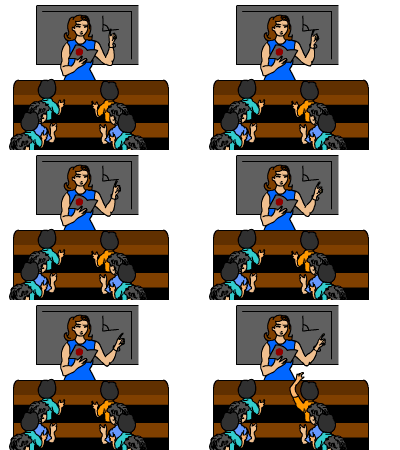 | To be an effective teacher in the year 2010 and beyond requires consideration of the teacher, the learner, learning and classroom processes.
|
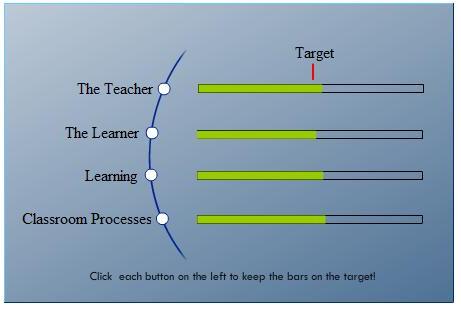
Test your Teaching Effectiveness
Click on the Game to PLAY
Effective teaching requires consideration of the teacher, the learner, learning and classroom processes.
Test your teaching effectiveness by maintaining a balanced focus on all four key areas.
Click each of the buttons on the left to keep the bars on target.
Good luck!
Rationale
Research suggests that students “exhibit a higher level of engagement and more positive attitudes” where technology and online resources are incorporated into lesson planning and learning outcomes (Sutherland, Robertson and John, 2009, p. 4).
This website aims to meet the following learning outcomes for the reader:
-
Understand the implications for effective teaching in the year 2010 and beyond.
-
Understand the relationships between effective teaching and the teacher, learner, learning theories and classroom processes.
-
Understand how effective teachers apply strategies and techniques, based on pedagogical knowledge of how children learn, learning theories and classroom management processes, to increase student motivation, active learning and on-task behaviour.
A website format has many advantages for enhancing teaching and learning, and offers exciting and engaging ways to address learning outcomes. Using ICT (Information and Communication Technology) to promote student-centred active learning enables the teacher to support different learning styles and diverse needs of students (Sutherland et al., 2009).
The benefits of a website, as an instructional tool, can be explained with a number of cognitive learning theories which consider how individuals process information, construct knowledge, and make sense of new information.
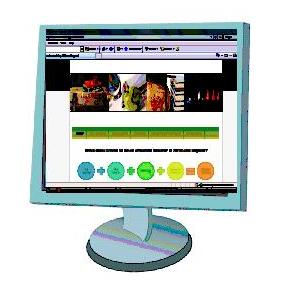 | "Our understanding of human memory strongly influences how we apply constructivist learning theory" (Eggen & Kauchak, 2009, p. 238)·There are six componants of the model of human memory which contribute to the advantage of using a website formate:
|
Attention
“All learning begins with attention, so learners will be unable to construct usable knowledge if they aren’t paying attention” (Eggen & Kauchak, 2009, p. 239). A website format, as opposed to a generic essay format, enabled this group to include animations, videos, a game, bright colours, and an interesting design to attract and maintain the reader’s attention. The interactive componant of the website actively involves the reader in learning, which makes them more attentive than they would be if they were simply passively reading text or listening to a lecture. Although animations and graphs would have been available in a powerpoint presentation, the interactive aspects such as the videos, games, and design variations would not have been.
Perception
“If students misperceive aspects of the information they’re studying, the knowledge they construct will be invalid” (Eggen & Kauchak, 2009, p. 239). In an essay, information is passively read in one format – text, whereas websites enable the information to be given in a variety of contexts which can reduce the incidence of misperceptions.
The limitations of working memory
“All forms of instruction can place a heavy cognitive load on students, so you should keep the limitations of working memory in mind as you guide students’ knowledge construction” (Eggen & Kauchak, 2009, p. 239). The use of a website as an instructional tool can help reduce the cognitive load placed on the reader in two ways: firstly, combining all the relevant aspects of effective teaching into four major topics, each with its own page, is a form of chunking – “the process of mentally combining separate items into larger, more meaningful units” (Miller, as cited in Eggen & Kauchak, p. 201); and secondly, including the visual aspect of the text and pictures with the verbal information provided on the videos is an example of using distributed processing – which capitalises on the independent processing capabilities of the visual and verbal processors.
Learners’ existing schemas in long-term memory
“Learners construct knowledge based on the knowledge (schemas) they already possess” (Eggen & Kauchak, 2009, p. 239), and their schemas are “cognitive constructs that organise information into meaningful systems on long-term memory” (Eggen & Kauchak, p. 202). Meaningful learning occurs when individual aspects of a schema are interconnected with other information. A website allows for the connection of knowledge and ideas by the use of in-text links which the reader can click on to see how the information from one section is connected and related to the other parts. This kind of explicit connection of knowledge is not available in any format other than the website.
Strategies that promote encoding, such as imagery, organisation, elaboration, and schema activation
"Information processing is a cognitive theory that examines the way knowledge enters and is stored and retrieved from memory (Eggen & Kauchak, 2001, p. 258). Eggen & Kauchak suggest models, such as the diagrams used on this website to demonstrate relationships between effective teaching and learning, aid in understanding abstract ideas and visualising concepts that can not be directly observed.
A website is an instructional tool that assists individuals in processing information and making connections in long-term memory, for meaningful learning and understanding (Eggen & Kauchak, 2001). Eggen & Kauchak suggest this process of meaningful encoding, which is “the process of placing information in long-term memory” (p. 273) can be enhanced through organisation, elaboration and activity.
Organisation
A website allows for information to be organised in a hierarchy for meaningful processing and understanding of relationships that exist between information on each web page (Eggen & Kauchak, 2001). The hierarchal nature of a website was considered a key advantage when considering formats for presenting this assignment, as a website enables large amounts of information to be organised in a clear and orderly structure, which can be easily visualised and processed by the reader.
Elaboration
Encoding is also enhanced through elaboration, “which is the process of making information meaningful by forming additional links in existing knowledge or adding new knowledge” (Willoughby, Wood & Khan, as cited in Eggen & Kauchak, 2001, p. 276). A website literally forms links between knowledge. This website has been designed to encourage elaboration through linking information which builds upon previous topics. For example, ‘The Teacher’ webpage discusses the importance of knowledge for effective teaching. Knowledge of learning theories that explain how children behave and construct knowledge are briefly discussed, and links have been created to take the reader to the ‘Learning’ and ‘Classroom Processes’ web pages which build upon these ideas in more detail.
Providing examples of “specific instances or cases that illustrate ideas” (Eggen & Kauchak, 2001, p. 276) is “perhaps the most powerful elaboration strategy” (Cassady, as cited in Eggen & Kauchak). A website is an effective tool for presenting examples to enhance information processing, for example through use of video clips, such as the you-tube clips included on the ‘Learning’ and ‘Classroom Processes’ web pages.
Cognitive Activity
“Regardless of the encoding strategy being employed, it is essential that learners are cognitively active when using the strategy” (Eggen & Kauchak, 2009, p. 213). The interactive aspect of the website places the reader in a cognitively active role, involving them in the navigation of the site, and allowing them to play the “Test your Teaching Effectiveness” game, a fun and engaging game that highlights the connection and relationships that exist between effective teaching and the teacher, the learner, learning theories and classroom processes.
A website format has many advantages for enhancing teaching and learning, and offers exciting ways to engage and motivate learners and promote active and meaningful learning.
This website was created for Assessment 2 for EDP128: Learning, Teaching and Assessment, 2009. This website is the collected work of group members in Tutorial Group E, Assessment Group 9: Sally Duke, Melinda Dunlop and Lisa Dunn.
