 Classroom Processes |
To be an effective teacher in the year 2010 and beyond requires consideration of the teacher, the learner, learning and classroom processes. In this section we will discuss classroom processes. "Effective teachers manage their classrooms with procedures and routines" (Wong and Wong, 2005 ). |
|||||
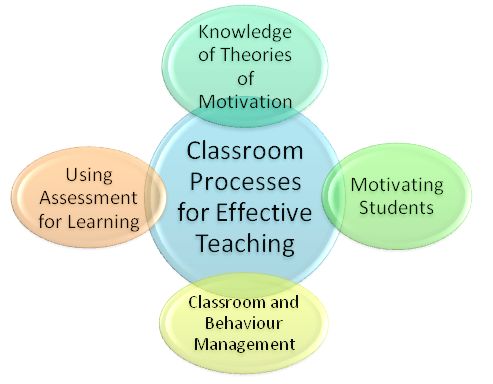
 An important aspect of being an effective teacher in the year 2010 and beyond is the ability to use classroom processes to maintain learner motivation; to create a productive learning environment; to ensure all learners feel safe; and to use assessment for learning. "Effective teachers manage their classrooms with procedures and routines" (Wong and Wong, 2005).
Theories of motivation Cognitive and social theories: Social cognitive theories explore "learners’ beliefs and expectations and the influence of observing others on our motivation” (Schunk & Pajares; Zimmerman & Schunk, as cited in Eggen & Kauchak, 2009, p. 287). Cognitive development is motivated by a student's need to understand and make sense of their experiences. Behaviourist theories: Behaviourist theories suggest changes occur in a student's behaviour as a result of an experience they have had. An example of a motivator, based on behaviourist theories, is the use of praise, comments and feedback on student's homework. Sociocultural theories: Sociocultural theories “focus on participation in a learning community (Hickey & Zuiker, as cited in Eggen & Kauchak, 2009, p. 288). A learning community is one in which all students participate in learning activities, differences in interests and thinking are respected, and the teacher and all students work together to help everyone learn” (Eggen & Kauchak, p. 288). Humanistic theories: Humanistic theories focus "on the whole person and views motivation as people's attempts to become self actualized, or to fulfil their total potential as human beings” (Schunk et al., as cited in Eggen & Kauchak, 2009, p. 288). Effective teachers use their knowledge of the theories of motivation to help students construct their own understanding by using classroom processes to motivate and engage students in active learning. The influence of needs on motivation to learn Maslow’s hierarchy of needs: According to Maslow's hierarchy of needs, an individuals deficiency needs must be met, that is the need for survival, safety, belonging and self esteem, before an individual can acquire growth needs, that is the need for intellectual intelligence, aesthetic appreciation and self-actualisation (Eggen & Kauchak 2009, p291). Need for self determination: “Self-determination is the need to act on and control one’s own environment” (Ryan & Deci, as cited in Eggen & Kauchak, 2009, p. 291). The “self determination theory assumes that people have three innate psychological needs” (Levesque et al.; Ryan & Deci, as cited in Eggen & Kauchak, p.291) being: · The need for competence · The need for autonomy · The need for relatedness The need to preserve self-worth: "Self-worth theorists suggest that people have an innate need to protect their sense of self worth and achieve self-acceptance" (Covington, as cited in Eggen & Kauchak, 2009, p. 294).
Motivation in the classroom An effective teacher motivates students within the classroom. For example, an effective teacher uses class structure "to create a mastery-focused environment for students" (Eggen & Kauchak, 2009, p. 320). Students who are motivated are more likely to do, and complete, all work, and are also more likely to accept their responsibilities. Effective teachers ensure students develop and realise their responsibilities, and help students understand that their behaviour and attitude influences the classroom environment. For example, if students show respect and listen to the teacher, the classroom can be a more positive environment. Classroom management Classroom management consists of “actions teachers take to create an environment that supports and facilitates both academic and social-emotional learning” (Evertson & Weinstein, as cited in Eggen & Kauchak, 2009, p. 354). An effective teacher successfully implements classroom management techniques. Classroom management is one of the most challenging tasks a teacher can face (Eggen & Kauchak, 2009, p. 352). According to Eggen & Kauchak, the three key factors that influence classroom management are: · Public and professional concerns about classroom management · The complexities of classroom life · The influence of orderly classrooms on learning and motivation The main problem for schools and classrooms, regarding classroom management, is not in discipline, but in a lack of procedures and routines in the classroom. An effective teacher has good and stable procedures and routines. They have procedures set out for the students to follow throughout the day, and have routines for students to follow daily or even weekly. An effective teacher communicates with parents effectively to learn about the student’s home environment. They encourage parents to be actively involved in their child’s academic life. For example, the teacher may arrange one on one meetings with parents to explain how the child is coping. Effective teachers also encourage parents to help their children with homework. Assessment “Classroom assessment includes all the processes involved in making decisions about students' learning progress” (Nitko; McMillan, as cited in Eggen & Kauchak, 2009, p. 434). An effective teacher observes and assesses students understanding through theory work, practical work and standardised testing. Classroom assessment also involves student’s performance assessment. For example, watching a primary school child write gives the teacher an understanding of the student's handwriting ability, spelling ability and knowledge of grammar and sentence structures. The teacher can use this information to plan appropriate lessons and build upon the student's current ability and understanding.
In the Classroom How effective teachers of today use classroom and behaviour management techniques successfully to motivate and engage students in active learning.
|
||||||